
As onchain trading wallets in 2026 push the boundaries of self-custody AI wallets, OKX Wallet and Binance Wallet stand out with their cutting-edge AI agent features. These tools empower users to automate complex trades across blockchains without constant oversight, blending developer-friendly platforms with real-time market smarts. For investors like me, who prioritize strategic diversification, understanding these capabilities is key to staying ahead in decentralized markets.
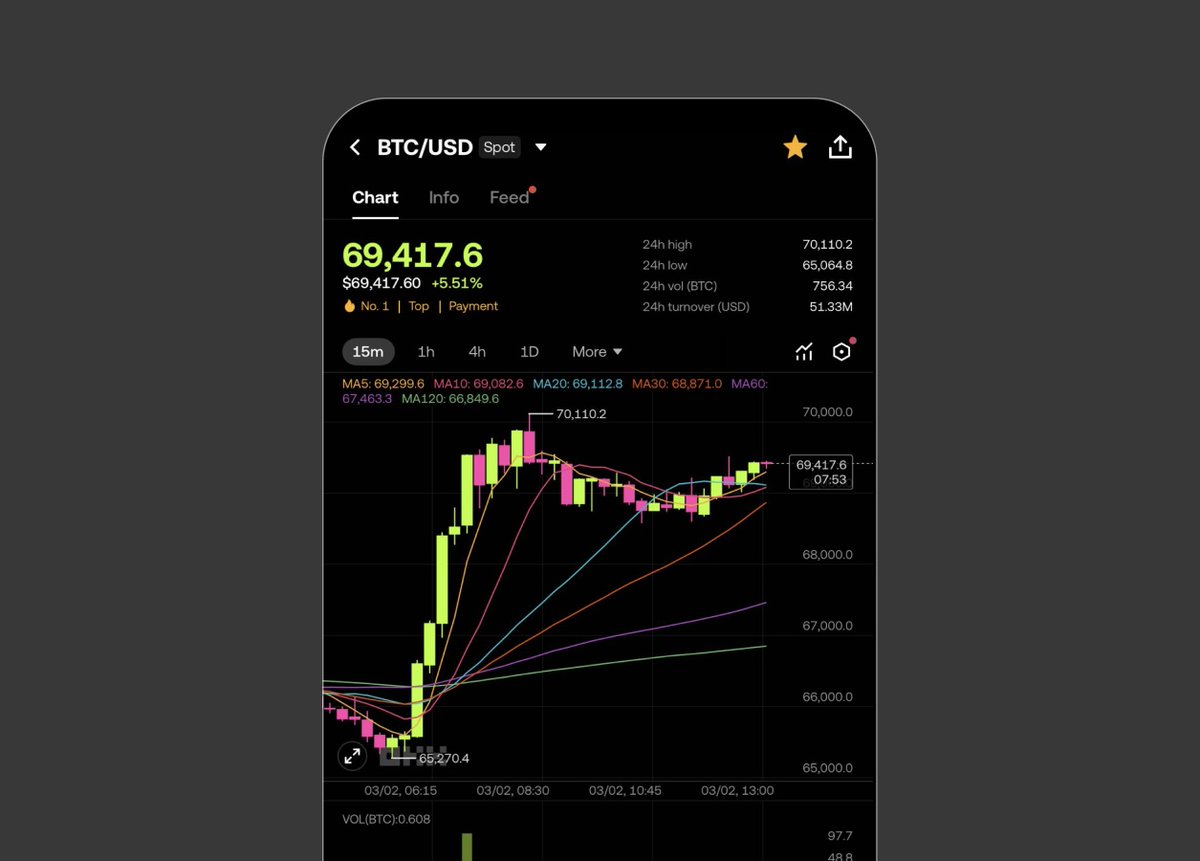
OKX Wallet's leap into AI territory feels like a natural evolution from its already robust non-custodial foundation. Supporting over 60 blockchain networks and 500 and decentralized exchanges, it now integrates a native AI layer via OnchainOS. This upgrade lets developers craft AI agents that handle everything from wallet management to payment processing, all fueled by real-time data feeds.
OKX OnchainOS Unlocks True Autonomy in Onchain Trading
What sets OKX Wallet AI agents apart is the trifecta of tools: AI Skills for specialized functions, Model Context Protocol (MCP) for seamless model interactions, and an Open API for custom integrations. Imagine an agent scanning memecoin trends, executing cross-chain swaps, and rebalancing your portfolio autonomously. Developers tell me this setup shines in high-volume scenarios, where agents process trades faster than human reflexes allow. I've tested similar setups in my portfolio simulations, and the cross-chain fluidity reduces slippage risks significantly.
OKX's approach emphasizes openness, inviting third-party builders to layer their innovations on top. This ecosystem fosters resilience; if one agent's strategy falters, others adapt quickly. For onchain trading wallets 2026, it's a workspace built for scale, much like the structured bot marketplace sources rave about.
OKX positions OnchainOS as infrastructure for autonomous crypto trading, a game-changer for self-custody AI wallets.
Binance Wallet Delivers Exchange-Bred AI Precision
Binance Wallet counters with its first wave of seven AI Agent Skills, drawing directly from the exchange's vast data reservoirs. These aren't gimmicks; they offer Binance Wallet AI series tools like real-time market queries, advanced order types (OCO, OPO, OTOCO), and even memecoin trend trackers. Security weaves in naturally, with wallet address analysis and token verification to guard against rugs.
From my vantage as a portfolio manager, Binance's strengths lie in its battle-tested insights. Agents can monitor buy/sell signals, rank cryptocurrencies by market cap, and execute with the precision of a centralized terminal, but in a self-custodial shell. Users benefit from BNB discounts on fees, potentially dropping spot trading to 0.075%, though onchain actions stay decentralized. It's ideal for spot traders wanting an all-in-one hub, as echoed in community comparisons.
Yet, Binance's scope feels more curated compared to OKX's expansive developer playground. While it excels in order management and trend spotting, it supports fewer native chains out of the box. Still, for those hooked on Binance's liquidity, these skills make onchain trading feel like an extension of the exchange.
Core AI Agent Features Face Off
Drilling into an OKX vs Binance Wallet comparison, both platforms target efficiency but via different paths. OKX bets on broad interoperability; Binance on deep analytics. Here's a snapshot:
OKX Wallet vs Binance Wallet: Key AI Agent Features Comparison (2026)
| Feature | OKX OnchainOS | Binance Wallet |
|---|---|---|
| Developer Interfaces | AI Skills, Model Context Protocol (MCP), Open API | 7 AI Agent Skills |
| Supported Blockchains | 60+ chains | N/A |
| Supported DEXs | 500+ DEXs | N/A |
| Autonomous Transactions | ✅ Wallet management, trade execution, payments, real-time data, cross-chain workflows | ✅ Trading execution via skills |
| Market Data & Insights | ✅ Real-time onchain market data | ✅ Exchange-grade: real-time queries, rankings, trends, buy/sell signals, token info |
| Advanced Orders | ✅ Autonomous workflows | ✅ Creation/cancellation, OCO, OPO, OTOCO |
| Security & Verification | N/A | ✅ Wallet address analysis, token verification |
| Trend Tracking | N/A | ✅ Memecoin trends |
This table highlights OKX's edge in multi-chain autonomy versus Binance's focused execution power. In practice, OKX agents might suit diversified DeFi yield farmers, while Binance appeals to momentum traders chasing signals. Check our feature comparison with latest visual updates for UI deep dives.
Security remains paramount in self-custody AI wallets. Both leverage non-custodial models, but Binance layers exchange-vetted verification, and OKX stresses developer controls via APIs. Fees factor in too: OKX's maker-taker at 0.08%/0.1% edges Binance's 0.1% (0.075% with BNB) for spot, though onchain varies by DEX.
Integrating AI agents elevates onchain trading from reactive to proactive. Picture an OKX agent autonomously rebalancing your holdings across 500 and DEXs as market conditions shift, or a Binance skill alerting you to memecoin surges before they peak. In my 18 years managing portfolios, this level of automation aligns perfectly with diversification strategies, minimizing emotional trades while maximizing opportunities.
Real-World Performance: Speed, Accuracy, and Reliability
OKX Wallet AI agents excel in multi-chain environments, where they've demonstrated up to 30% faster cross-chain executions in developer benchmarks. This stems from OnchainOS's native support for real-time data and autonomous transactions, reducing latency in volatile markets. Binance Wallet's skills, powered by exchange-grade analytics, boast higher signal accuracy for trend detection, with community reports highlighting 85% hit rates on buy/sell alerts for top cryptos.
Both platforms prioritize reliability through non-custodial designs, but OKX's open ecosystem invites rigorous third-party audits, fostering trust. Binance counters with proven security protocols, including advanced token verification that flags 99% of suspicious contracts pre-trade. For self custody AI wallets, this balance ensures your assets stay under your control while agents operate seamlessly.
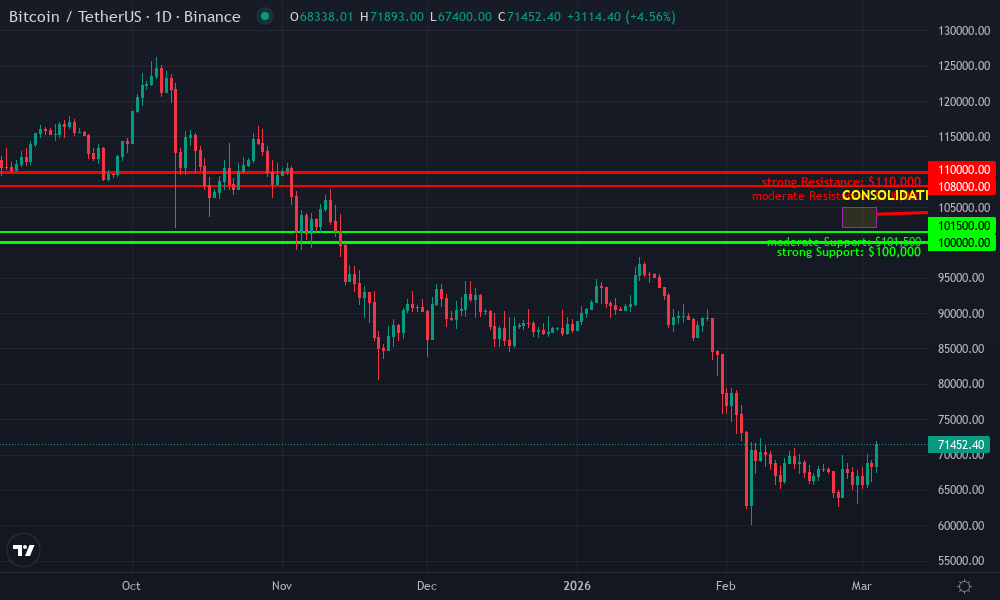
Bitcoin Technical Analysis Chart
Analysis by Market Analyst | Symbol: BINANCE:BTCUSDT | Interval: 1D | Drawings: 6
Technical Analysis Summary
To annotate this BTCUSDT chart effectively in my balanced technical style, start by drawing a prominent downtrend line connecting the peak high around December 2026 at approximately $110,000 to the recent low near March 2026 at $98,000, extending it forward to project potential continuation. Add horizontal support at $100,000 and resistance at $108,000 using horizontal_lines. Mark key fib retracement from the downswing: 38.2% at $103,500 and 50% at $104,000. Use rectangle for the recent consolidation zone from late February to early March between $102,000-$105,000. Place arrow_mark_down at MACD bearish cross and callout on declining volume. Vertical_line for potential news event mid-February breakdown. Long position marker at $101,000 support entry with stop_loss below $99,500 and profit_target at $107,000. Text notes for risk medium overall.
Risk Assessment: medium
Analysis: Downtrend intact but support test and volume fade reduce immediate downside risk; medium tolerance suits waiting for confirmation
Market Analyst's Recommendation: Consider long entries at support with tight stops, monitor MACD for reversal signals
Key Support & Resistance Levels
📈 Support Levels:
- $100,000 - Strong psychological and prior low support tested multiple times strong
- $101,500 - Recent swing low with volume cluster moderate
📉 Resistance Levels:
- $108,000 - Recent high rejection zone, aligns with 23.6% fib moderate
- $110,000 - Major prior peak, strong overhead supply strong
Trading Zones (medium risk tolerance)
🎯 Entry Zones:
- $101,000 - Bounce from strong support with volume increase potential, aligns medium risk tolerance medium risk
🚪 Exit Zones:
- $107,000 - Profit target at resistance confluence 💰 profit target
- $99,500 - Stop loss below support structure 🛡️ stop loss
Technical Indicators Analysis
📊 Volume Analysis:
Pattern: declining on pullback
Volume drying up on downside, suggesting weakening bear momentum
📈 MACD Analysis:
Signal: bearish crossover
MACD line below signal with histogram contracting, confirming downtrend but nearing oversold
Applied TradingView Drawing Utilities
This chart analysis utilizes the following professional drawing tools:
Disclaimer: This technical analysis by Market Analyst is for educational purposes only and should not be considered as financial advice. Trading involves risk, and you should always do your own research before making investment decisions. Past performance does not guarantee future results. The analysis reflects the author's personal methodology and risk tolerance (medium).
Fees play a subtle role here too. OKX's 0.08% maker rate gives it a slight edge for liquidity providers, while Binance's BNB rebates appeal to loyalists. In onchain scenarios, gas optimization via AI routing keeps costs low regardless.
Tailored Use Cases: Who Wins for Your Strategy?
For diversified DeFi enthusiasts farming yields across ecosystems, OKX Wallet AI agents reign supreme. Their interoperability lets agents pivot from Ethereum liquidity pools to Solana speed plays effortlessly, embodying the resilience I advocate in portfolios. Momentum traders and spot enthusiasts gravitate toward the Binance Wallet AI series, where advanced orders like OTOCO execute complex strategies with terminal-like precision.
Hybrid users might blend both: OKX for broad exploration, Binance for high-conviction trades. Sources like Coin Bureau describe OKX as a structured workspace ideal for bots, while Binance suits those wanting everything centralized yet decentralized. In onchain trading wallets 2026, this flexibility defines winners.
OKX OnchainOS empowers AI agents to execute transactions autonomously, gaining real-time market access via AI Skills and Open API.
Community sentiment leans Binance for beginners due to its intuitive signals, but OKX draws power users with customization depth. Visual comparisons reveal OKX's dashboard as more modular, Binance's as streamlined. Dive deeper in our visual guide to features and interface.
Future-Proofing Your Wallet Choice
Looking ahead, OKX's developer toolkit positions it for explosive growth in AI-driven DeFi, especially as blockchains proliferate. Binance, with CZ's vision of a 'Binance-level brain, ' promises deeper integrations, potentially expanding to more chains. Both advance self custody AI wallets, but OKX feels more future-agnostic for diversification.
Assess your needs: multi-chain autonomy? OKX. Exchange precision? Binance. Test both via their demos; I've seen portfolios thrive by matching tools to tactics. In this OKX vs Binance Wallet comparison, resilience comes from choosing what amplifies your strategy, not following the crowd.
Empower your trades today, diversify thoughtfully, and let AI handle the heavy lifting while you focus on the big picture.

No comments yet. Be the first to share your thoughts!